Khajuraho: A small town in the Bundelkhand region
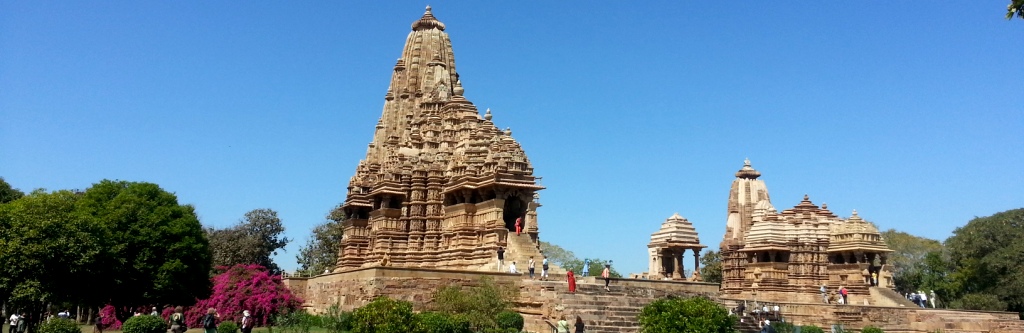
Khajuraho Tempel: History of the Kamasutra
The temples of Khajuraho are also very well visited sites of India. Over 1000 years ago, under the rule of the Chandela-Rajput kings of central India, thousands of stonemasons must have been busy building the original 85 temple structures, which were constructed within an astonishingly short period of only 100 years, between 950 and 1050 AD. They are characterized by countless magnificent, elaborate reliefs and sculptures and were added to the list of World Cultural Heritage Sites by Unesco in 1986. Immortalized in the finest sandstone, there are depictions of mythical creatures, gods and sky dancers. In addition, however, there are also extremely permissive images of erotic and uninhibited acts, of masturbation, group sex, fellatio and even sodomy, obviously inspired by the Kamasutra. Lust as a divine creative principle was depicted in all its facets and down to the smallest detail. When in 1833 the British officer T.S. Burt rediscovered the complex, which had been forgotten for over seven centuries and was overgrown by the jungle, this was also the reason why the English society, which was characterized by prudery at that time, reacted to his discovery less enthusiastically than rather shocked. 22 of the once 85 temples were still preserved and almost intact. But Queen Victoria is said to have initially considered having the “highly indecent, downright obscene” buildings destroyed. Only after lengthy discussions did the English also come to the conclusion that the works of art immortalized on the interior and exterior walls of the temples represented a legacy of inestimable value. In Indian temple architecture, the entire temple precinct is unique. The temples stand on a high, masonry platform rather than at ground level within an enclosure, as is usually the case. The rising roofs of the main chambers rise like tall mountains above the crowns of the trees. Together with the height of the temples, this creates an impression of elegance and lightheartedness, reminiscent of the peaks of the Himalayas.
The Western Group
The temples of Khajuraho are divided into three geographical groups: Western, Eastern and Southern group. The most beautiful and impressive temples are located in the “Western Group”. The largest temple is the Kandariya Mahadev, which is dedicated to Shiva. The slender 31 meter high tower symbolizes the mythical world mountain Meru. The outer walls are adorned with three rows of more than 900 figures up to one meter high. Most of the depictions of various sexual practices can be found here, and it is not uncommon to see young male visitors giggling in front of the images. Also outstanding are the many female figures, depicted voluptuously and in the most diverse poses: A woman writing a letter, one loosening her girdle, another undressing, yet another coyly hiding behind her hand. Even the scrutinizing look in the mirror and the making up of the eyes were impressively immortalized in stone. The Devi Jagadambe temple on the same platform has particularly fine stone sculptures. North of it and facing east, toward the rising sun, is the Chitragupta Temple of Surya, the sun god. Inside is an impressive 1.5 meter high image of this powerful god driving a chariot drawn by seven horses. The group scenes depicted on the outside include royal processions, elephant fights, hunting scenes and community dances. The lavish lifestyle of the Chandela kings and their court is shown here in all its splendor. The Vishvanath temple resembles the Kandariya Mahadev temple. Lions flank the northern and elephants the southern staircase leading to the temple and the outer walls are lavishly decorated. In front of the Vishvanath temple, the giant Nandi bull, Shiva’s mount, stands in a hall. Among the Vishnu temples, the huge Lakshmana temple is the most beautiful. The platform on which the temple rests is decorated by remarkable friezes depicting a mixture of martial and sexual scenes. Thus, one observes armies of soldiers going into battle, processions of elephants couples in the act and a soldier mating with a mare. The lintel above the entrance depicts the trinity of Brahma, Vishnu and Shiva, as well as Vishnu’s consort, Lakshmi. Also not to be missed is the Vahara shrine directly across the street: It contains a representation of Vishnu in his incarnation as a boar. The surface of the 2.75 m high statue is covered with 674 small images of deity figures from the Hindu pantheon.
The Eastern Group
Besides the western group, the Jain temples of the eastern group are worth seeing. They are closest to the village of Khajuraho. The facades of the largest Jain temple, the Parashvanath temple, and the smaller Adinatha temple hardly differ from those of the Hindu temples. Here, too, Hindu gods as well as everyday activities of mortals are depicted – a woman sits lost in thought over a letter, a young girl removes a thorn from her foot… Only the Tirthankara idols are peculiar to the Jain temples. They are recognized by three umbrellas, the rhombus-shaped jewel of knowledge on their chest and their nakedness.