Jaisalmer: the golden city of the Thar desert
Jaisalmer: The Desert City
330km from Bikaner, 570km from Jaipur and 290km from Jodhpur lies the desert city of Jaisalmer in western Rajasthan. Less than 100km away is the border with Pakistan. Jaisalmer is therefore the last large city near the border. Jaisalmer was founded as the capital in 1156 by the then Bhati ruler Rawal Jaisal. For the construction of the city, the entire surface of the local golden colored sandstone was used, which has given the place Jaisalmer the nickname “Golden City”. The golden color of the stone shines like gold in the sun. It is difficult to distinguish between rock and building. The fortress “Jaisalmer Fort”, also called “Golden Fort”, towers over the city and saved it from numerous enemies at that time. Jaisalmer is located directly on the former caravan route and therefore became rich quickly. Several times it was taken by Islamic enemies, but the Bhati rulers always brought it back under their own rule. Due to the increasing port and railroad construction in the colonial period, the caravan town lost its importance and was abandoned by many traders. In the 20th century, tourism increased greatly thanks to the better infrastructure and the city became more lively again. To strangers, the seclusion of Jaisalmer seems very mystical, as if from 1001 nights. The narrow streets, the large fortress, the beautiful, finely chiseled decorations of the havelis (large residences of rich people) and the desert culture, have attracted people from all over India and the world. The numerous beautiful complexes have always fascinated the guests. The many filigree stone carvings of the old buildings became more and more elaborate and beautiful. Also many new houses are decorated with beautiful motifs on niches and columns. It is overwhelming to walk through the narrow streets and to catch a glimpse of the everyday life of the people. The houses built side by side protect against direct sunlight and sandstorms. Likewise, one always has a close connection to the neighbors. The many stores in the alleys look back to the old trading days of the city. But in the meantime there are almost too many stores, some of which unfortunately sell counterfeit goods. However, some renowned stores, which we recommend, offer very good goods. For example: Fabrics, carvings and souvenirs. Since Jaisalmer is not very big you can easily walk around the city. In the winter, the climate in the desert is perfect for taking a camel ride on the sand dunes, enjoying a beautiful sunset and photographing the unique surroundings. In the meantime, there are also many tent camps that provide a real desert atmosphere. In the evening you will dive deeper into the culture of the desert inhabitants with traditional folk music and dance.
Top Tourist Attractions in Jaisalmer
The Golden Fort Jaisalmer: Sonar Qila
Founded in the 12th century, the fort is the focal point of Jaisalmer. It was built on a triangular rock and is surrounded by high walls and bastions. The golden fort is a World Heritage Site under the title: “Hills Forts of Rajasthan”. It is a defensive fort that protected the Bhati rulers from enemies. In the fort still stands the palace where the royal family resided for centuries. The palace is finely decorated with stone carvings and has some good vantage points that provide a beautiful view of the city. In an eastern corner of the fortress, one such viewpoint is marked with an old cannon. There are also some beautiful and ancient temples in the fort. Jaisalmer Fort is the only fort in India where the people are allowed to live. Currently about 300 families live in the fort and some even offer small accommodations for backpackers. Good hotels with large facilities can be found outside the fort or on the outskirts of town. Gadisar Lake: In the 14th century, the king of the time built a lake on the outskirts of the city that collected rainwater and served as the main source of water. Today it is used mainly for washing and watering animals. The lake used to be a meeting place for the people during festivals. On the southern side of the lake there are old temples and on the west there is a high gate built by a concubine. The people did not accept this and the gate was destroyed. She then built a small temple to God Krishna to appease the people. In Gadisar Lake there are many hungry catfish that are fed by the Indians.
Sand dunes and camel ride in Sam
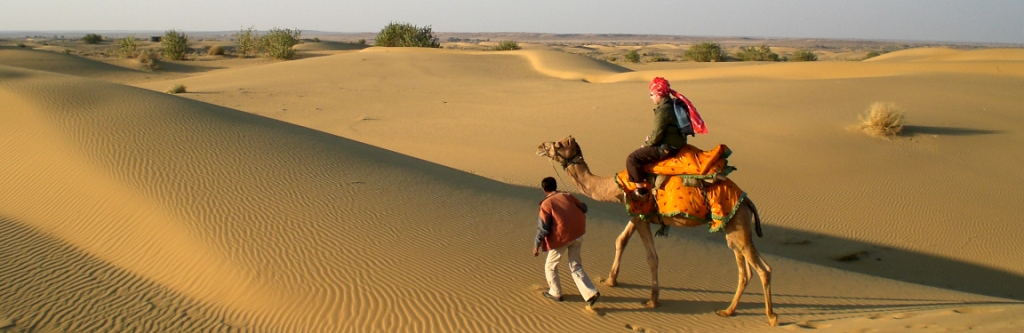
About 40 km from Jaisalmer towards the Pakistani border lies the village of Sam. There the real desert with its numerous sand dunes begins. On the way you will be surprised how densely populated this desert is. The roads in the district of Jaisalmer are in good condition and have been built and maintained by the Border Road Organization, a branch of the Indian military. This drive will bring you closer to the life of the desert and its culture. Afterwards, you can ride dromedaries over the sand dunes in Sam and enjoy an unforgettable sunset. Havelis: Many rich merchants used to live in Jaisalmer. In their heyday, they built large, spectacular homes called havelis. The havelis are attractions of the city. These large dwellings were decorated and furnished with the best materials of their time. The most beautiful thing about these havelis are the stone carvings made of yellow sandstone. Common motifs include lotus flowers, birds such as peacocks, elephants, and figures of gods and men. It is amazing how the craftsmen could chisel such fine motifs from sandstone with simple tools. The most famous havelis Patwa Haveli: Built in the 19th century, Patwa Haveli was the residence of a rich merchant who was also the king’s finance minister. He had a huge haveli built for his five sons, which is the largest and most beautiful one today. The multi-storey haveli has many rooms and numerous beautiful niches and balconies made of yellow sandstone.
Nathamal ki Haveli
Haveli is located on the way to Patwa Haveli. It has several floors, is still inhabited by the owners and is therefore a private complex. Two Muslim brothers were responsible for the decoration of this facade. The construction site was divided and both worked independently. This resulted in different representations which, however, harmonize with each other. You have to look closely at the motifs to notice any differences. Salim Singh ki Haveli This haveli was built in the 17th century by the then Prime Minister Salim Singh. He was very ambitious and always tried to outdo the others. For this reason, the Salim Singh Haveli was built with a dome-like tower. He wanted to build the haveli as high as the royal palace, but he did not succeed. It is worth visiting and photographing it.This haveli is located on the way to Patwa Haveli. It has several floors, is still inhabited by the owners and is therefore a private complex. Two Muslim brothers were responsible for the decoration of this facade. The construction site was divided and both worked independently. This resulted in different representations which, however, harmonize with each other. You have to look closely at the motifs to notice any differences. Salim Singh ki Haveli This haveli was built in the 17th century by the then Prime Minister Salim Singh. He was very ambitious and always tried to outdo the others. For this reason, the Salim Singh Haveli was built with a dome-like tower. He wanted to build the haveli as high as the royal palace, but he did not succeed. It is worth visiting and photographing it.
Hotels in Jaisalmer