Pushkar: The Holy City
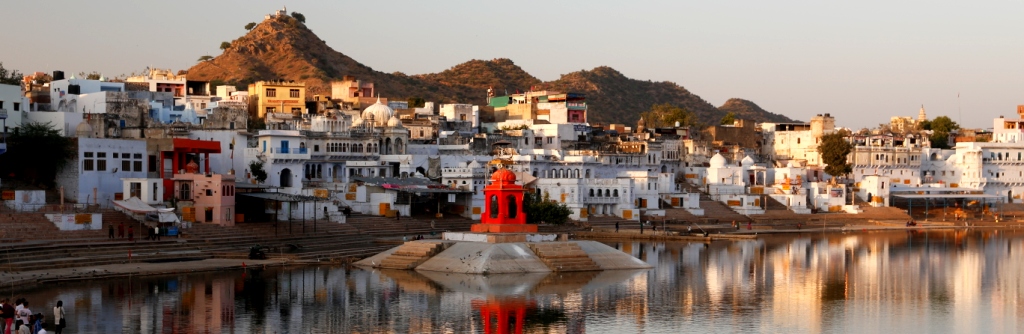
Pushkar: The City of Hindu pilgrimage
The small town of Pushkar, about 11 km northwest of Ajmer, has one of the highest densities of temples in India, with over 400 temples, and is one of the holy cities of Hinduism. The place is famous mainly because of its lake, which attracts hundreds of thousands of pilgrims every year. According to legend, Brahma, the creator of the world, once flew over the earth on his divine mount, the goose Hansa, in search of a suitable place for a sacrifice. To decide which place this should be, he threw a lotus flower on the earth. Where the leaves landed, an underground spring immediately gushed forth and a lake was formed. Brahma chose this place for his sacrifice and named it “Pushkar” after the lotus. For the Hindus, Pushkar has held outstanding religious significance ever since. Ghats and old town The lake, which is centrally located in the town, is considered the holiest lake in India and is surrounded on all sides by 52 bathing steps, called ghats, built by the princes of Rajasthan. The Varah ghat is considered particularly sacred because Vishnu is said to have once appeared here in the form of a boar. The two other main ghats, the Brahma ghat and the Gau ghat are used for ritual ablutions. Pilgrims bathe there and purify themselves from the sins of their lives in prescribed rituals called pujas. These ceremonies are performed only by the men of the Brahmin caste resident in Pushkar. Many pilgrims also perform the last rituals here for a deceased person from their family. To purify themselves, they have their hair cut before taking a bath in the lake. One cannot escape the spiritual atmosphere in Pushkar. Already at four o’clock in the morning the drums and bells of the Brahma temple call for the first prayer ritual and in the evening at sunset one hears again the sound of the conch shell, with which the Aarti, the sung prayer, is blown. Photography is prohibited at the ghats, however, and one should exercise a certain caution , from self-appointed priests who like to give tourists flowers to throw them into the lake. For such rituals or other blessings then often a lot of money is demanded. Despite the many pilgrims, Pushkar is a rather cozy and comparatively quiet place that invites travelers to stay and also attracts many dropouts and backpackers. In the small alleys you can find all kinds of souvenir stores, cafes and restaurants, while in front of the Brahma temple long rows of stores line up, where you can buy sweets as offerings, flower garlands, color powder, statues of deities, incense, oil lamps or even cult images for the home altar.
Brahma temple
The Brahma temple in Pushkar is one of very few existing Brahma temples in India. It is considered one of the holiest Hindu temples because it is said to be the only place on earth where Brahma has manifested himself. The original 14th century temple was destroyed by the last Mughal emperor, Aurangzeb, for whom this popular Hindu shrine near the major Islamic pilgrimage site in Ajmer was a thorn in his side. Reconstruction of the temple, financed mainly by donations, began in the first half of the 18th century. The temple is worth a visit for the silver turtle embedded in the floor at the entrance and the four-faced statue of Brahma with its gleaming golden eyes in the inner sanctum. There is also a beautiful view of the surrounding area from the surrounding walls.
Pushkar Mela
Once a year, on the last five days before the full moon of the Indian month of Kartik (October/November), Pushkar is the destination of one of the biggest Hindu pilgrimages, the Pushkar Mela. These days are absolutely high season in Pushkar, prices skyrocket and hundreds of thousands of pilgrims flock to the small town. Whoever takes a bath in the holy lake at this time, and especially on the night of the full moon “Kartik Purnima”, is said to be freed from all sins. At night, the believers put countless small leaf boats with flowers and oil lamps on the water as an offering to the gods, which then slowly float on the lake – an unforgettable sight. But the Pushkar Mela is not only a religious event. For the duration of the festival, a huge tent city is erected at the gates of Pushkar and the small town is transformed into the largest camel market in the world. More than 50,000 camels, dressed up by their owners to the nines, are offered for sale, along with horses and other livestock. For the visitors, some of whom travel from remote desert villages, the Pushkar Mela is the major event of the year and a fair and wedding market in one. When the afternoon camel races are over, the fair is filled with gambling and food stalls, and pilgrims mingle with magicians, sadhus, musicians, acrobats, gurus, jugglers and crooks. No Western visitor will be able to escape the atmosphere. The cliché of fairy-tale India still seems very real here, when bold-looking male figures with impressive mustaches and turbans haggle over camels in the dunes, blacksmiths handle medieval tools, or the smoke of hundreds of campfires rises into the desert sky between the tents in the evening. In the evening light, the viewer is presented with images of almost unheard-of poetry that he will not soon forget. Anyone visiting Rajasthan at this time of year should not miss the overwhelming experience of the Pushkar Mela.